






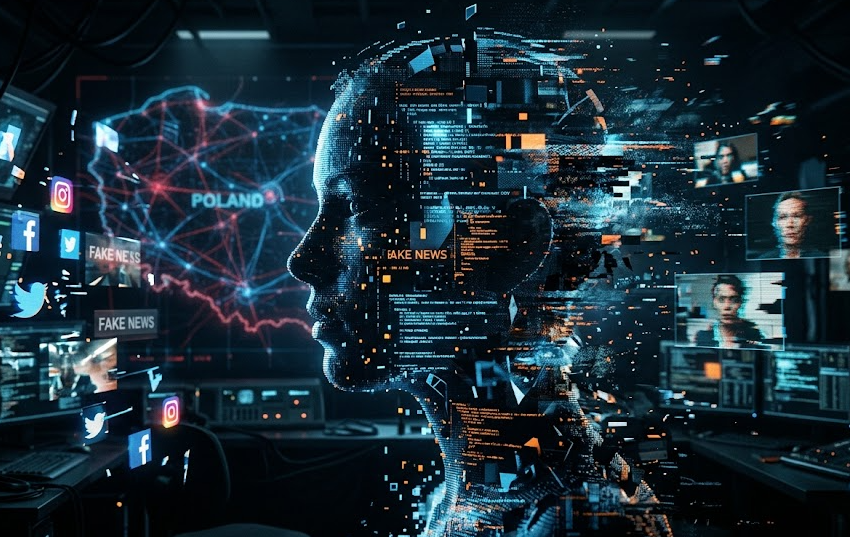
How AI Is Transforming Disinformation in Poland: Risks for Democracy and National Security
- AI is no longer just an efficiency tool — it has become a force multiplier for modern information operations.
- Deepfakes and voice cloning are now operational tools used in fraud, influence campaigns, and political manipulation.
- Poland remains a high-value target due to its geopolitical role, proximity to the war in Ukraine, and internal polarization.
- Disinformation is shifting from “content problem” to “infrastructure problem”, enabled by automation and scale.
- Resilience now depends less on debunking and more on verification culture and institutional trust.
Artificial intelligence has introduced a structural shift in the information environment. What was once a domain dominated by human-driven propaganda, coordinated bot networks, and manually produced fake narratives is now increasingly automated, scalable, and adaptive.
In practice, this means that the cost of producing persuasive false narratives has dropped dramatically, while their realism and distribution speed have increased. For security analysts, this represents not an incremental change, but a qualitative transformation of the threat landscape.
For Poland, this evolution is particularly significant. The country is simultaneously a NATO frontline state, a key logistical hub for Ukraine, and one of the most politically engaged societies in Central and Eastern Europe. These factors make it a frequent target of hybrid influence operations, especially those linked to Russian information doctrine, which has historically relied on narrative disruption and societal fragmentation.
How AI Changed the Logic of Disinformation
Traditional disinformation required coordination. Operators needed content creators, translators, fake account networks, and distribution channels. Even low-cost campaigns had operational bottlenecks.
AI removes many of these constraints. Large language models can now generate persuasive articles, social media posts, and commentary at scale. Image generation tools can fabricate “evidence”, while audio models can replicate voices with minimal training data.
This shift creates a new operational logic: instead of producing one convincing false narrative, actors can generate thousands of micro-variations tailored to specific audiences, increasing the probability of engagement and belief.
According to assessments from European cybersecurity institutions such as ENISA, synthetic media is expected to become one of the dominant vectors of information manipulation in the near term, particularly in politically sensitive environments.
Real-World Context: Poland and the Regional Threat Landscape
Poland has already been exposed to multiple waves of coordinated disinformation activity in recent years. These have included narratives related to:
- the war in Ukraine and refugee migration flows,
- energy security and dependence on external suppliers,
- NATO presence in Eastern Europe,
- internal political polarization and electoral legitimacy.
Organizations such as NASK (Polish National Research Institute) have repeatedly warned about coordinated information campaigns targeting Polish-speaking audiences, often amplified through social media platforms and cross-border media ecosystems.
A key shift introduced by AI is that these campaigns no longer require large-scale infrastructure. Even relatively small groups can now simulate “mass public opinion” through automated content generation and coordinated posting patterns.
The Rise of Synthetic Media: Deepfakes and Voice Cloning
1. Deepfake Videos
Deepfake technology enables the creation of realistic video footage in which individuals appear to say or do things they never actually did. While early versions were visibly distorted, current systems can produce highly convincing results even under moderate scrutiny.
In a Polish or European context, the risk is not theoretical. A synthetic video attributed to a political leader released during an election cycle or geopolitical crisis could spread faster than verification mechanisms can respond.
Historical precedent from earlier non-AI disinformation campaigns shows that even low-quality fake content can influence perception in the short term. AI significantly amplifies this effect by increasing realism and reducing production time.
2. AI Voice Cloning
Voice synthesis systems now require only seconds of audio to generate convincing replicas of human speech. This introduces a new category of risk: real-time impersonation.
Security analysts have already documented cases globally where cloned voices were used in fraud attempts targeting corporate executives. In a national security context, similar techniques could be used to simulate emergency announcements or fabricated official communications.
3. Automated Content at Scale
Beyond visual and audio manipulation, the most impactful change is scale. AI enables continuous generation of text-based content across platforms, languages, and ideological angles.
This allows influence operators to maintain persistent narrative pressure, reinforcing specific themes over time until they begin to appear socially validated through repetition.
From Information Manipulation to Security Threat
Modern security frameworks increasingly treat information integrity as a core component of national resilience. The objective of contemporary disinformation is often not persuasion, but erosion of trust.
When trust in media, institutions, and official communication channels declines, societies become more vulnerable to instability during crises. This is particularly relevant in hybrid threat environments, where cyberattacks, physical incidents, and information operations may occur simultaneously.
In this context, AI does not introduce a new category of threat but significantly accelerates and scales existing ones.
Traditional vs AI-Powered Disinformation
| Factor | Traditional Disinformation | AI-Powered Disinformation |
|---|---|---|
| Production Model | Human-driven coordination | Automated generation pipelines |
| Speed | Hours to days | Seconds to minutes |
| Cost | Moderate to high | Very low per unit |
| Scalability | Limited by manpower | Near-unbounded |
| Personalization | Broad audience targeting | Micro-targeted messaging |
| Detection Complexity | Moderate | High and increasing |
Why Platform Dynamics Amplify the Risk
Social media platforms introduce a structural amplification layer. Recommendation algorithms optimize for engagement, not accuracy. This creates a natural advantage for emotionally charged or controversial content, regardless of its authenticity.
AI-generated content fits this environment particularly well. It can be rapidly adapted to trending topics, local languages, and specific communities, allowing it to blend into organic information flows.
As a result, the distinction between authentic public discourse and coordinated manipulation becomes increasingly blurred.
What This Means for Poland
For Poland, the convergence of geopolitical pressure and AI-enabled content generation creates a persistent information security challenge.
The most significant risk is not a single viral piece of fake content, but sustained erosion of epistemic trust — the ability of society to agree on basic facts.
This has direct implications for democratic processes, crisis response mechanisms, and public resilience in periods of uncertainty.
How to Respond to AI-Driven Information Threats
- Shift from content verification to source verification — focus on provenance, not appearance.
- Assume synthetic possibility by default for highly emotional or unexpected multimedia content.
- Strengthen institutional communication channels as primary verification anchors during crises.
- Invest in digital literacy at scale, not just technical detection tools.
- Recognize that speed of response is now a security variable, not just a communication metric.
Closing Thoughts
Artificial intelligence is reshaping the information environment faster than most regulatory or institutional frameworks can adapt. While the technology itself is neutral, its application in influence operations introduces new asymmetries in scale, speed, and realism.
For Poland and similar states operating in high-pressure geopolitical environments, resilience will depend less on eliminating disinformation entirely and more on reducing its strategic impact.
In the long term, the decisive factor may not be the sophistication of synthetic content, but the strength of societal trust and the ability to maintain shared factual baselines in an increasingly synthetic information space.
ADVERTISEMENT